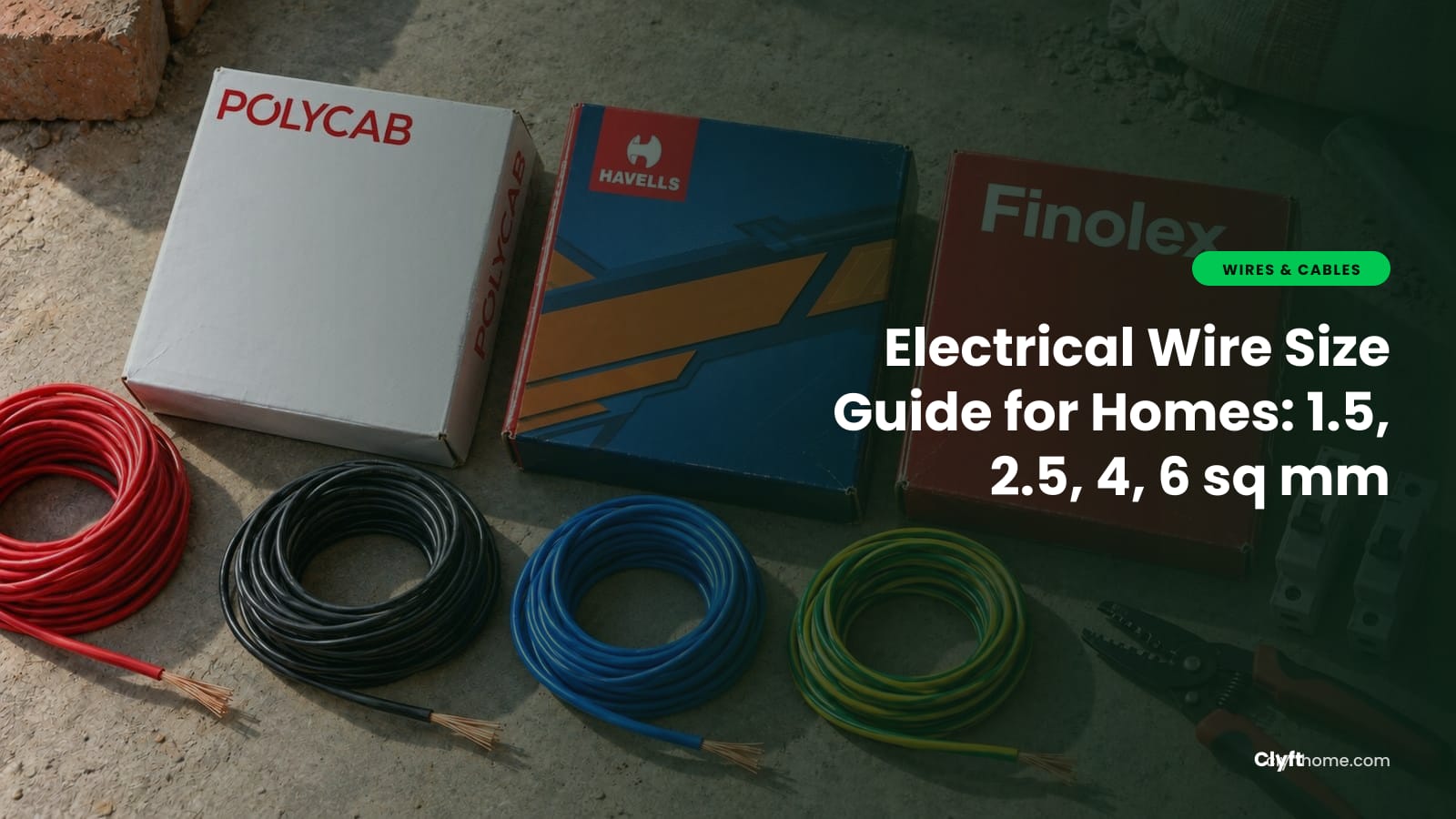
For most Indian homes the quick answer is this: use 1.5 sq mm copper for lighting and fan circuits, 2.5 sq mm for general power sockets, 4 sq mm for heavy appliances like a geyser or air conditioner, and 6 to 10 sq mm for the mains. Wire is sized by the cross-section of its copper conductor in square millimetres (sq mm), and choosing the right size keeps the cable cool, safe and within voltage-drop limits. This guide breaks down each size, its approximate current rating and where it belongs in your home.
How is electrical wire size measured?
House wiring cable is described by the cross-sectional area of the copper conductor inside it, measured in square millimetres. A 2.5 sq mm cable simply means the copper core has a cross-section of 2.5 square millimetres. The bigger that number, the more current the cable can carry safely before it heats up.
In India, PVC-insulated copper building wire is manufactured to IS 694, the standard for insulated cables up to 1100 volts. When you buy cable, look for the ISI mark and the printed sq mm size on the sheath. Do not confuse sq mm with the older SWG (Standard Wire Gauge) numbering, most modern Indian brands print sq mm directly.
Wire size chart for house wiring
The table below gives the common copper cable sizes, their approximate current-carrying capacity (ampacity) and the typical job each one does in a home. Treat the ampacity figures as a practical guide: the real rating depends on how the cable is installed (in conduit, bunched with other cables, ambient temperature) and is confirmed on the manufacturer's datasheet.
| Wire size (sq mm) | Approx ampacity | Typical use in a home |
|---|---|---|
| 1.0 | 11 to 14 A | Light points, ceiling fans, individual lighting drops |
| 1.5 | 14 to 16 A | Lighting circuits, combined fan and light circuits |
| 2.5 | 20 to 23 A | 5A and 15A socket / power circuits, general plug points |
| 4.0 | 26 to 30 A | Geyser, 1 to 1.5 ton AC, kitchen appliances |
| 6.0 | 32 to 40 A | Larger AC, cooktop / hob, sub-mains |
| 10.0 | 45 to 55 A | Mains / incomer |
What size wire for each part of your home
Lighting and fan circuits (1.0 to 1.5 sq mm)
Bulbs, tube lights, LED panels and ceiling fans draw very little current, so 1.0 sq mm handles individual light points and 1.5 sq mm is the safe default for a full lighting circuit feeding several rooms. Keeping lighting on its own thinner cable, separate from power sockets, means a fault at a socket does not plunge the whole floor into darkness.
General power sockets (2.5 sq mm)
Your everyday 5A and 15A plug points, the ones running a television, fridge, mixer, phone chargers and similar, are wired in 2.5 sq mm copper. This size carries the roughly 20 to 23 amps these circuits are designed for and leaves headroom so the cable does not run hot. Do not wire sockets in 1.5 sq mm lighting cable to save money, it is the most common undersizing mistake in home wiring.
Heavy appliances: geyser, AC and kitchen (4 to 6 sq mm)
High-wattage appliances need their own dedicated circuit in thicker cable. A geyser or a 1 to 1.5 ton air conditioner is typically run in 4 sq mm. A larger air conditioner, an induction cooktop or a hob draws more and may need 6 sq mm. Each of these should have its own dedicated run back to the distribution board and its own protective device, never share a heavy appliance with a general socket circuit.
Mains and sub-mains (6 to 10 sq mm)
The incomer that feeds the whole board, and any sub-main running to a separate floor or outbuilding, carries the sum of everything downstream. That is why the mains is usually 6 sq mm or 10 sq mm copper, sized from a proper load estimate. Getting the mains right matters more than any single circuit, because it is the cable everything else depends on.
Copper or aluminium wire?
For internal house wiring, copper is the standard. Copper conducts electricity better than aluminium, so for the same cross-section a copper conductor carries more current and runs cooler, and it is more robust at connections and terminations. Aluminium is lighter and cheaper, which is why it is used mainly for the service mains, the overhead or underground line the utility runs to your meter. Inside the home, stick with copper for every circuit.
Why longer cable runs may need a bigger size
Current flowing through a long cable loses a little voltage along the way, an effect called voltage drop. Over a short run it is negligible, but on a long run to a far bedroom, a pump or a distant outbuilding it can become large enough that appliances underperform and cable heats up. Wiring codes keep this drop small, commonly within a few percent of the supply voltage.
The practical fix is simple: on a long run, go one size up. A circuit that would use 2.5 sq mm over a short distance might be wired in 4 sq mm if the run is long, purely to keep voltage drop in check. When in doubt, upsize, thicker cable is never a safety problem, only undersized cable is.
Wire colour codes in Indian homes
Correct colour coding keeps wiring safe to work on and easy to fault-find. Current Indian practice follows the international convention, though you will still find the older colours in existing homes:
| Conductor | Current colour | Older colour |
|---|---|---|
| Phase (live) | Brown, black or grey | Red, yellow or blue |
| Neutral | Blue | Black |
| Earth | Green, or green with yellow stripe | Green |
The earth conductor is always green or green-and-yellow, never reuse it for anything else. Consistent colours across the whole house are what let an electrician work safely years later.
Safety checklist before you buy
If the house is in Hyderabad, the wire is only one line on the material list. See buy construction materials in Hyderabad for cement, steel, blocks, bricks and cable quoted together by verified suppliers.
- Never undersize for heavy loads. A geyser or AC on a thin socket cable is a fire risk, match the wire to the appliance and its dedicated circuit.
- Always earth. Every circuit needs a proper earth conductor back to the earth pit. Earthing is what makes your protective devices work.
- Buy ISI-marked cable to IS 694. The ISI mark and printed sq mm size are your assurance the conductor is genuine full-section copper.
- Match the circuit's protective device. Wire size and MCB rating go together, see the companion guides below.
- Prefer copper for every internal circuit and keep colour coding consistent throughout the house.
Get the sizes right, protect every circuit and earth everything, and your home wiring will be safe for decades. To turn these sizes into a shopping list, the house wiring calculator gives the coils of each size a house needs. When you are ready to buy, see today's wire and cable prices in Hyderabad or browse ISI-marked copper cable in every common size on wires and cables, or see the full catalogue in all products.